Saturday, May 25, 2013

Research that Benefits Children and Families


There are so many different needs and uses for research on children and/or families. I believe that the very notion of early childhood education started as an inquiry that sparked research and thought it necessary to establish a foundation that would serve a pillar for advancement in the field. Various topics come to my mind when I think about research involving children including medical, societal, and educational research.
As we proceed throughout this course piecing together the process of research in efforts of becoming competent in doing early childhood research, my task this week is to share a positive example of the effects of research on children and/or families. In early childhood education, children need certain components in their environments that promote safety, healthy development, and well-being.  Within these environments are a web of supporters that contribute to their abilities to learn and their capacities to adjust and adapt through resiliency. Research done on the relationships of children with their caregiver has provided evidential benefits in the field of early childhood education. Theories of secure attachments have supported the ideals of the critical need for infants to develop relationships and how it encourages their sense of security, independence, and competence. As children mature, the roles that these individuals play in their education has proven to be effective attributes in their academic success as well.
                Going further into research, I explored articles that discussed the benefits of research on children relevant to child development. The pioneers in this field have researched the virtues that foster how children grow, development milestones that support growth, and further more activities that can encourage growth. In today’s society, bullying has become the force behind many childhood suicides and attempts, increase in dropout rates, and peer on peer violence. Research that focuses on the behavior of children can be helpful in assisting professionals in understanding the characteristics of the actions and reactions. Behavioral research can also aid in implementing intervention and prevention service that can combat challenging behaviors.
                In my opinion, if we continue to research utilizing ethically sound guidelines, then we as professionals in the field of early childhood care and education will be able to maximize the quality of care of programs being provided to children and families, enhance learning and teaching techniques and strategies of educators, advocate for strong successful families, and a plethora of other crucially important conditions that benefit the lives of children and families through research. 


Saturday, May 18, 2013

My Personal Research Journey


There are many topics in the field of early childhood education that stimulates my interest. My chosen topic of interest is school improvement. I believe that all young learners need and deserve high quality childcare both locally and globally. Although there are many obstacles that we must first overcome, I believe that it is possible to achieve by addressing such attributes as the achievement gap, school readiness, culture and diversity, and investments and policies.
                I have been in the field of early childhood care and education for over 12 years. I have experienced three different early childhood care and education organizations that varied in the quality of care and services that were offered to their children and families. Each one of these experience has given me different perspectives on how programs operate on different levels. I have gained a wealth of insight in this field throughout my professional and educational journey but I have yet to conduct research in the field of early childhood care and education. I am open to learning about this process, becoming a competent researcher, and ready to see what the end result will be in my first research project.
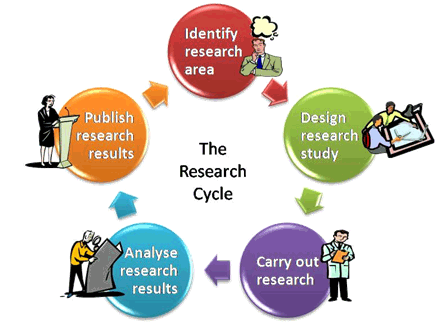
                The text book for this course has been extremely interesting and pertinent to my comprehension of doing early childhood research. Constructing the research chart this week has given me a solid foundation for starting this research in the right way. I believe that starting this research properly will yield positive and correct results and advance evidence for other researchers to build upon. Thus far, this course has provided insight in the research process as a methodical one that takes time and patience. I am enthusiastic about learning about the research process because it is crucial in my professional and educational journey.
                I believe that course will equip each of us with the necessary tools to conduct research that will benefit the field of early childhood care and education.  If you have any research, opinions, insights, advice, or suggestions that will assist me please feel free to let me know.  As colleagues in this online learning community, please do hesitate to let me know if I can be of any assistance to any of you. I look forward to becoming a part of your resource portfolio. 


Reference:  http://www.google.com/imgres?imgurl=http://southernbellelibrarian.files.wordpress.com/2011/09/research_cycle.gif&imgrefurl=http://southernbellelibrarian.wordpress.com/2011/09/07/general-design-issues-in-research/&h=326&w=436&sz=35&tbnid=LwWneZF8u8ujyM:&tbnh=91&tbnw=122&zoom=1&usg=__LKforKEyE9DuIvRn5xSlY8WCsrI=&docid=gvV6CiPsMYPrkM&sa=X&ei=9_KXUd3uLoqm9gT7_4GYBQ&ved=0CFgQ9QEwDQ&dur=7967